
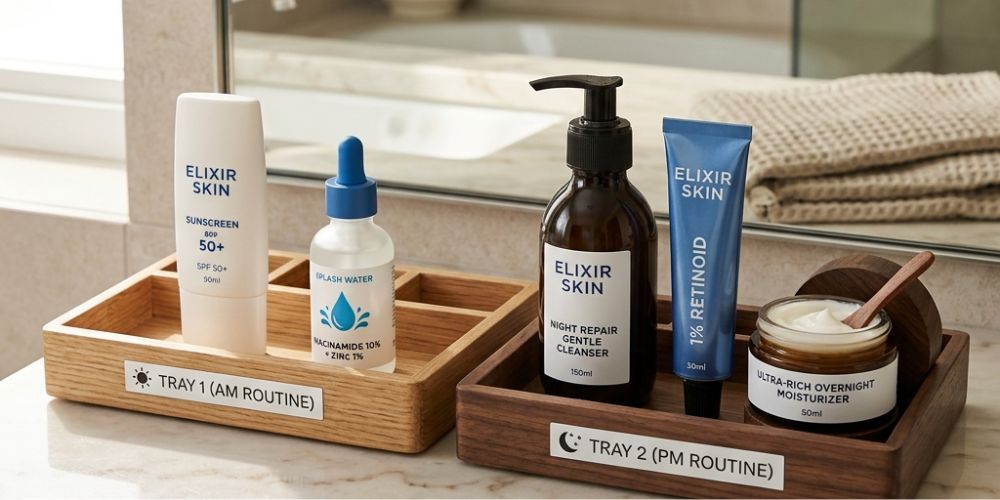
A good skincare routine does not need to be long, expensive, or complicated. What matters most is using the right products at the right time of day and keeping the routine simple enough to do consistently.
Morning and nighttime skincare serve different purposes. In the morning, the priority is protection. At night, the focus shifts to cleansing, repair, hydration, and recovery. Once that distinction is clear, it becomes much easier to decide which steps are essential, which are optional, and where products like retinoids, exfoliating acids, and red light therapy actually fit.
Understanding the Different Purposes of AM and PM Skincare
Your skin faces different demands during the day than it does while you sleep.
In the morning, your skin is about to deal with environmental stressors such as sunlight and everyday exposure. That is why daytime skincare is mainly about prevention and defense.
At night, skin naturally shifts into a recovery mode. There is more transepidermal water loss while you sleep, which means skin can become more prone to dryness. Night is also the time many people choose to use active ingredients and richer moisturizing products.
That does not mean you need two elaborate routines. It simply means the goal of each routine is different.
How to Build the Ideal Morning Skincare Routine: Focus on Protection
For most people, a morning routine can be as short as one to three steps.
1. Cleanse only if needed
Not everyone needs to wash their face with cleanser first thing in the morning.
- If your skin is oily or sweaty, a morning cleanse may help.
- If your skin is normal to dry, splashing with water may be enough.
- If your skin is very sensitive or easily irritated, it may be better to skip the morning cleanse altogether.
People dealing with redness, burning, stinging, rosacea flares, or dermatitis may especially benefit from not over-cleansing in the morning.
2. Use an antioxidant serum if you want to
This step is optional, not mandatory.
If you use an antioxidant serum, morning is a common time to apply it. Examples mentioned include:
- Vitamin C
- Niacinamide
- Glutathione
These ingredients are typically used to help skin deal with free radicals from environmental exposure.
If you do not use an antioxidant serum, your routine can still be effective.
3. Moisturize if your skin needs it
A separate moisturizer in the morning is also optional.
If your skin tyour sunscreen is already in a moisturizing base.
4. Apply sends to feel dry, adding moisturizer can help. If not, you may be able to skip it, especially if unscreen generously
This is the most important step in a daytime skincare routine.
Look for a sunscreen with SPF 30 or higher and apply it liberally to:
- Face
- Neck
- Ears
One of the main reasons sunscreen fails is simple: not enough is applied.
If you are spending extended time outdoors or expect sweat and humidity, a water-resistant formula may be the better choice. For mostly indoor days with short periods outside, SPF 30 is generally a solid baseline.
Daily use matters even when you are not planning much outdoor time. Small incidental exposures add up over time, and regular sunscreen use offers the best protection against premature skin aging and skin cancer.
The Minimalist 1-Step Morning Skincare Routine
If you want the most minimal routine possible, this can be enough for some people:
- Wake up
- Apply sunscreen
- Done
This works because sunscreen often does more than provide UV protection. Many formulas also help with moisture retention, and some contain beneficial ingredients such as niacinamide.
Using fewer products can also make it easier to apply sunscreen properly and thoroughly, which is more valuable than rushing through multiple steps.
The Ideal Nighttime Skincare Routine: Focus on Repair and Recovery
Nighttime skincare is where cleansing and recovery take center stage.
1. Wash your face
A nighttime cleanse is the one step that makes sense for nearly everyone.
It helps remove:
- Sunscreen
- Makeup
- Oil and sebum
- Cosmetic residue
- Environmental debris such as pollen and airborne irritants
Skipping nighttime cleansing can contribute to irritation and buildup. In some cases, neglecting facial cleansing can also allow excessive buildup on the skin and worsen issues related to skin flora and mites.
Should you double cleanse?
Double cleansing is optional, but it can be helpful if you wear makeup or heavier sunscreen.
A common approach is:
- Use an oil cleanser first to break up makeup and residue
- Follow with a gentle cleanser to wash everything away
This can make removal more efficient and reduce the need to rub the skin aggressively, which can cause irritation.
If you do not wear much makeup or prefer a shorter routine, a single mild cleanser may be all you need.
2. How to Apply Active Skincare Treatments at Night (Retinoids & Acids)
Night is a common time to use stronger treatment products, especially retinoids.
Retinol and retinoids
Retinol is part of the broader retinoid family, which includes topical forms of vitamin A. These ingredients are commonly used to:
- Improve visible signs of skin aging
- Support collagen production
- Reduce the look of wrinkles
- Help with hyperpigmentation
- Treat acne
If you use a retinoid, apply it after cleansing.
There are two common approaches:
- On damp skin, which may enhance penetration
- On dry skin, which may be easier to tolerate if irritation is a concern
If you are new to retinoids, expect the possibility of dryness, peeling, and irritation in the first few weeks.
The moisture sandwich method
If retinoids are irritating your skin, a moisture sandwich can help.
The basic sequence is:
- Apply a lightweight hydrating serum or light moisturizer
- Apply the retinoid
- Apply another layer of moisturizer
This method, sometimes called buffering, can make a retinoid easier to tolerate. Some people need it only at the beginning, while others find they can stop once their skin adjusts.
When to use chemical exfoliants
Chemical exfoliants include:
- Salicylic acid
- Alpha hydroxy acids such as glycolic, lactic, and mandelic acid
- Polyhydroxy acids, which tend to be gentler and more hydrating
The best rule is simple: use the product as directed, then adjust based on how your skin responds.
There is no universal schedule that applies to every exfoliating product. Some formulas may be appropriate once daily, some twice daily, and some less often. Frequency depends on both the product and your skin.
Morning or night?
Chemical exfoliants can be used in the morning, at night, or both, depending on the product instructions and your tolerance.
If you are new to retinoids, it is usually wise not to combine an exfoliating acid with your retinoid right away. Doing both too soon can increase dryness, peeling, and irritation.
Once your skin is more accustomed to a retinoid, combining products may be easier for some people. But the right frequency still depends on your skin’s response.
How to know if you are overdoing it
Back off if you notice:
- Excessive dryness
- Peeling
- Irritation
- Burning or stinging
At the same time, using an exfoliant far less often than instructed because of generic internet advice may keep you from getting the intended benefits.
Do you need a moisturizer at night?
Many people benefit from using a moisturizer as the final step of their nighttime routine, but not everyone needs one every night.
Moisturizers help:
- Reduce transepidermal water loss
- Improve skin hydration
- Support barrier function
- Decrease dryness from retinoids
- Reduce the appearance of fine dehydration lines
Better hydration can also help skin exfoliate more naturally, since low water content can interfere with normal skin shedding and barrier-related processes.
When you might skip moisturizer
You may not need a separate nighttime moisturizer if:
- Your skin does not feel tight, dry, or irritated
- You naturally retain moisture well
- Your active treatment is already in a moisturizing cream base
If your skin feels tight or squeaky after cleansing or treatment, that is a clue moisturizer may help.
Your moisture needs can change
Night cream needs are not static. They often vary based on:
- Season, especially during winter and low humidity
- Indoor heating
- Life stage, including menopause, when skin often becomes drier
When and How to Use Red Light Therapy in Your Skincare Routine
Red and near-infrared light devices are used for photobiomodulation. In skincare, they are commonly used with the goal of helping reduce inflammation, improve circulation, and support collagen production through effects on fibroblasts.
Morning or night?
Either can work. There is no required time of day.
The most important rule is that the device should be used on clean, bare skin.
Do not place a mask over freshly applied serums, lotions, or creams that are still damp. Doing so can increase the chance of irritation because the mask can occlude those products against the skin. Clean skin also allows for more even light exposure.
Two practical ways to use it
- Morning: Use it before your skincare routine starts
- Night: Use it after cleansing, then apply your usual products afterward
How often should you use a red light mask?
Follow the manufacturer’s instructions.
More frequent use is not automatically better. Depending on the device and its dosing, using it too often may work against the results you want.
The Bare Minimum Skincare Routine: Essential Steps for Consistent Results
If you want a routine that requires the least effort possible, this is a sensible starting point.
Minimal morning routine
- Wash your face only if you need to
- Otherwise, splash with water or do nothing
- Apply sunscreen generously to face, neck, and ears
Minimal nighttime routine
- Wash your face
- Apply moisturizer only if your skin feels dry or tight
That is enough for many people. You do not need serums, exfoliants, or treatment products unless they serve a specific purpose for your skin.
Common skincare mistakes to avoid
Using too many products
A longer routine is not automatically a better routine. More products can mean more irritation, more confusion, and less consistency.
Skipping sunscreen because you are mostly indoors
Daily sunscreen still matters because brief everyday exposure accumulates over time.
Not applying enough sunscreen
Even a great formula will underperform if applied too sparingly.
Over-cleansing sensitive skin in the morning
If your skin is reactive or inflamed, less cleansing may be better.
Starting retinoids and exfoliating acids at the same time
This can be too irritating for beginners.
Following arbitrary exfoliation rules
Product directions and your skin’s tolerance matter more than generic schedules from social media.
Using red light therapy over damp skincare
Clean, bare skin is the safer and more practical approach.
How to build a routine you will actually stick with
The best routine is one you can maintain.
A practical framework looks like this:
- Start with the basics: cleanser, sunscreen, moisturizer if needed
- Add one active at a time: such as a retinoid or exfoliant
- Pay attention to your skin: dryness, peeling, and irritation are signs to adjust
- Keep it simple: fewer steps often lead to better consistency
Bottom line
Morning skincare should focus on protection, and nighttime skincare should focus on cleansing and recovery.
For most people, the essentials are straightforward:
- Morning: sunscreen, with cleansing and antioxidants as optional additions
- Night: cleanse, then use treatment products and moisturizer only as needed
Retinoids, exfoliating acids, and red light therapy can all have a place in a routine, but they are not required for everyone. A minimal routine can be highly effective, especially when it is easy to repeat every day.
If your current routine feels overwhelming, simplifying it may actually improve your results.

1 thought on “Morning vs Night Skincare: A Stylist’s Guide to What Really Matters”
I discovered this spot while searching for a trustworthy online casino and it has exceeded my expectations. The game library is packed with quality slots and table games that actually pay out fairly. Their welcome bonus is generous and the loyalty program rewards regular players nicely.